
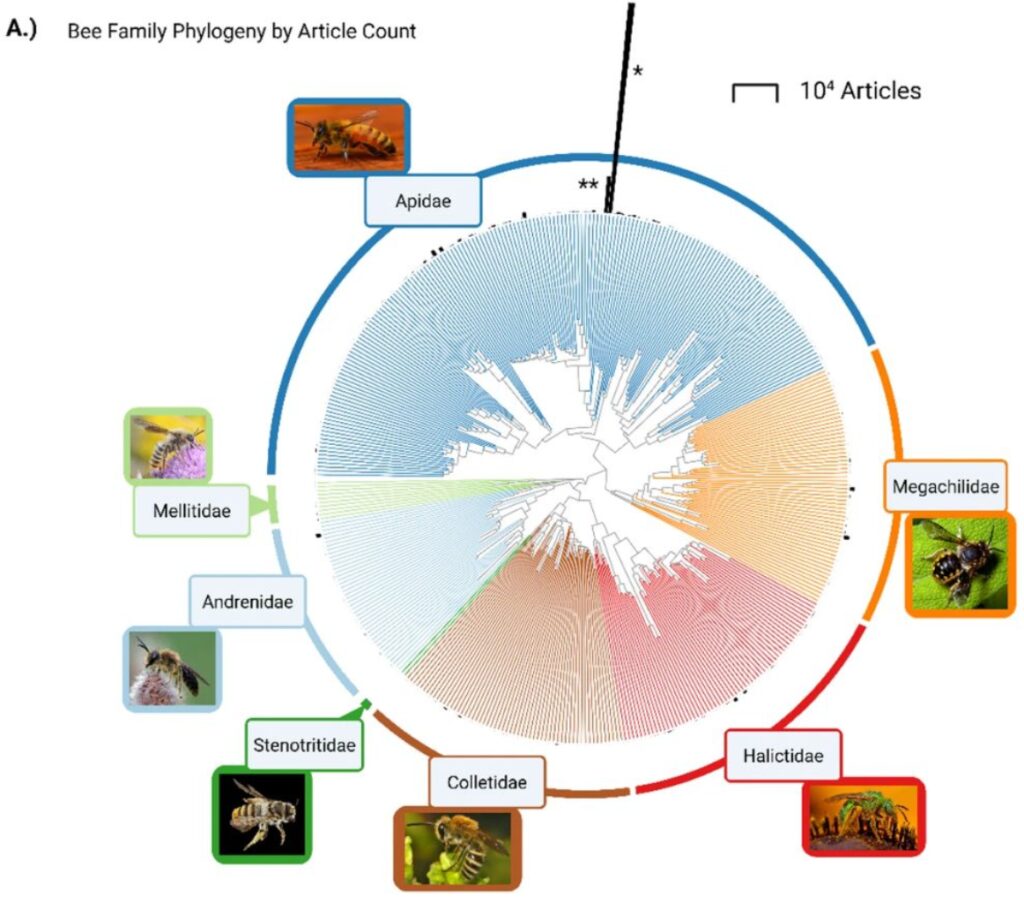
Bees are essential to ecosystems and food security — but do we really have a balanced understanding of global bee ecology and how bees respond to environmental change?
New research by Miles Nesbit analyses nearly 70,000 bee-related publications to ask a simple but important question: does research effort align with ecological importance?
The answer is largely no.
Research is overwhelmingly concentrated on a small number of managed, social bees, particularly Apis (honeybees) and Bombus (bumblebees). Yet many wild, solitary, and ground‑nesting bees – including taxa that are structurally central in plant–pollinator networks – receive little attention. Crucially, the bees we study most are often not those most important for maintaining pollination network resilience.
The paper quantifies these biases and highlights where research effort, monitoring, and policy should be redirected if we want evidence‑based conservation outcomes that reflect real ecological leverage.
Read the research: https://www.nature.com/articles/s41598-026-41830-7
Nesbit, M.L., Montauban, C., Windram, F. et al. Mapping global bee research with traits and plant-pollinator interaction networks. Sci Rep 16, 12844 (2026). https://doi.org/10.1038/s41598-026-41830-7