
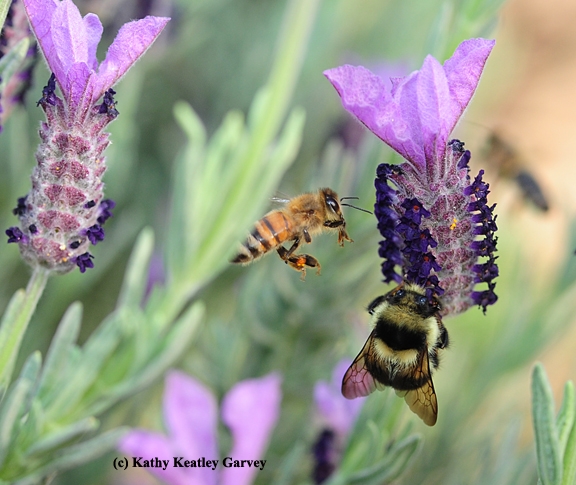
 Whilst we know a lot about the foraging preferences of honey bees, little is known about the foraging preferences of bumblebees. In this new study, we show that whilst the majority of foraging bumblebees are generalists (feeding on both pollen and nectar), some bumblebees do specialise on only foraging for pollen, and some specialise on nectar. Believing this may be linked to the different sizes of bumblebee foragers that a colony produces, we set about looking for relationships between this foraging preference and the body size, fat content, sucrose sensitivity and ovary size of the workers.
To learn more about this work, which was led by Dr Adam Smith (now at George Washington University), please click here
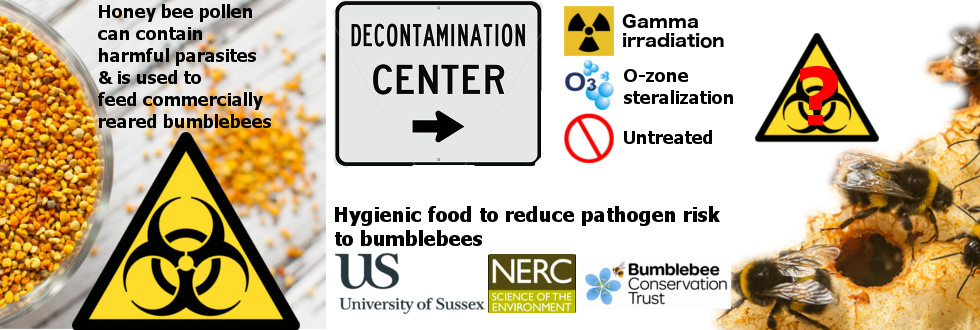 The bumblebee industry relies heavily on pollen to feed the bees. This pollen is harvested from the legs of honeybees then fed to bumblebees. The problem with this is that it may contain parasites that are infective to bumblebees!
 The deformed wing virus (DWV), known to be ubiquitous in honey bees, has now been detected in bumblebees. In addition, the neogregarine Apicystis bombi has been discovered to be more prevalent than previously thought. Here, we assess for the first time the lethal and sublethal effects of these parasites during single and mixed infections of worker bumblebees (Bombus terrestris). Overall, we find that A. bombi exhibits both lethal and sublethal effects. DWV causes lethal effect and may reduce the sub lethal effects imposed by A. bombi. The results show that both parasites have significant, negative effects on bumblebee health, making them potentially of conservation concern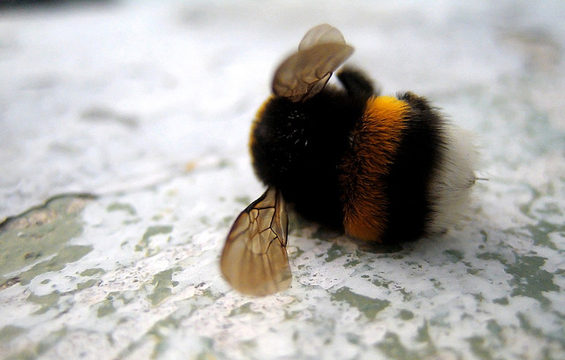
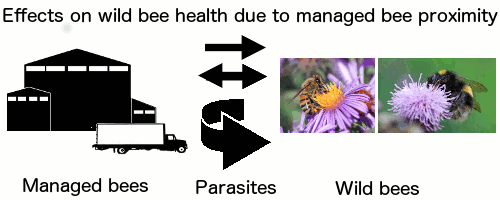
 A. bombi from Argentina and Europe share a common, relatively recent origin. The absence of genetic structure across space and host species suggests that A. bombi may be acting as an emergent infectious disease across bee taxa and continents.
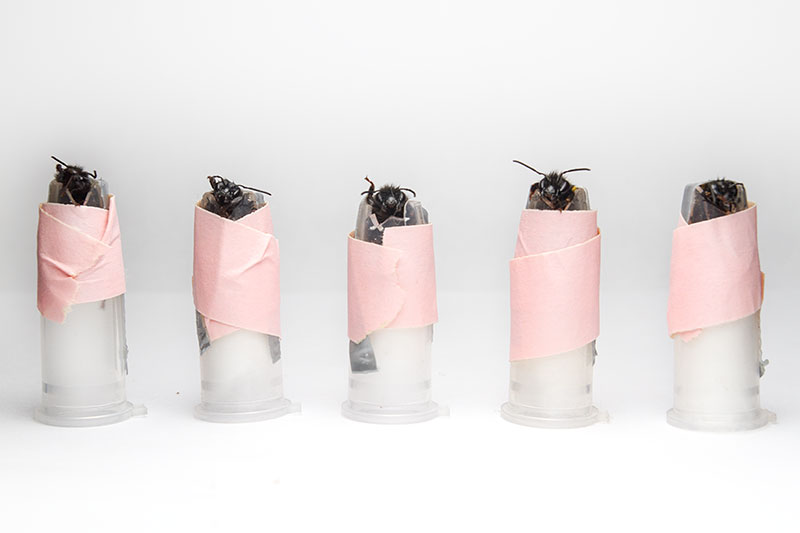
 Results from my newly published work,
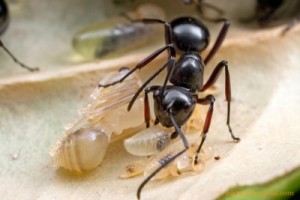
 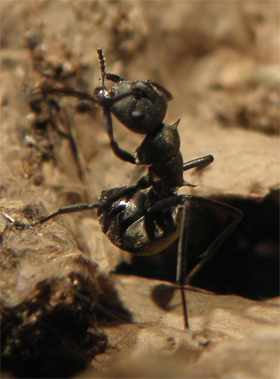 Here we used the generalist entomopathogenic fungus Metarhizium to compare the disease resistance of a species of a weaver ant, Polyrhachis dives, which has lost the metapleural gland, with that of the well-studied leaf-cutting ant Acromyrmex echinatior and two other ant species, Myrmica ruginodis and Formica fusca, all of which have metapleural glands.