
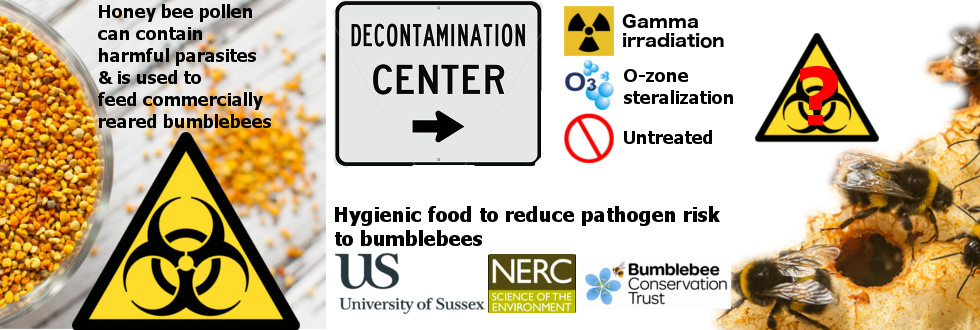
 The bumblebee industry relies heavily on pollen to feed the bees. This pollen is harvested from the legs of honeybees then fed to bumblebees. The problem with this is that it may contain parasites that are infective to bumblebees!
By working in collaboration with one of the largest global suppliers of bumblebees (Biobest), the English regulating body (Natural England), the Bumblebee Conservation Trust, and funded by NERC, we move a step closer to reducing parasite spread in bees! This new article details exactly how much of the different, know parasites, are found in pollen intended for bumblebee feed. Then, we test how abundant these parasites are when the pollen is treated with sterilisation processes including Gamma irradiation and a new ‘O-zone sterilisation’ technique. Finally, we feed bumblebees the different pollens and monitor their survival and physiology.
The results of this directly inform Biobest and other bumblebee breeders on what methods better maintain parasite free bumblebees, thus reducing the potential for global parasite spread.
Please click here to read more
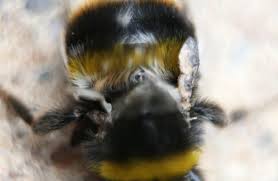 The deformed wing virus (DWV), known to be ubiquitous in honey bees, has now been detected in bumblebees. In addition, the neogregarine Apicystis bombi has been discovered to be more prevalent than previously thought. Here, we assess for the first time the lethal and sublethal effects of these parasites during single and mixed infections of worker bumblebees (Bombus terrestris). Overall, we find that A. bombi exhibits both lethal and sublethal effects. DWV causes lethal effect and may reduce the sub lethal effects imposed by A. bombi. The results show that both parasites have significant, negative effects on bumblebee health, making them potentially of conservation concern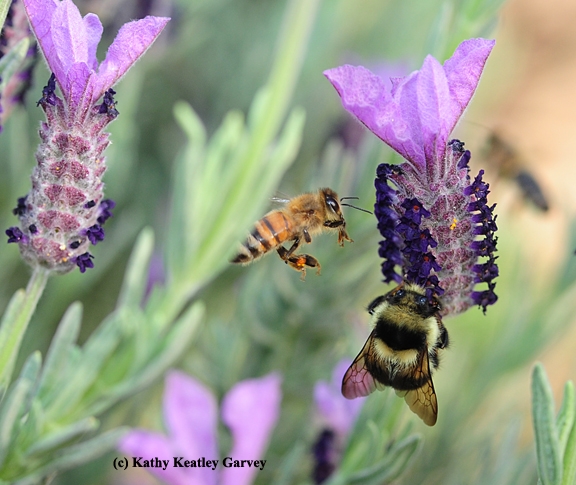
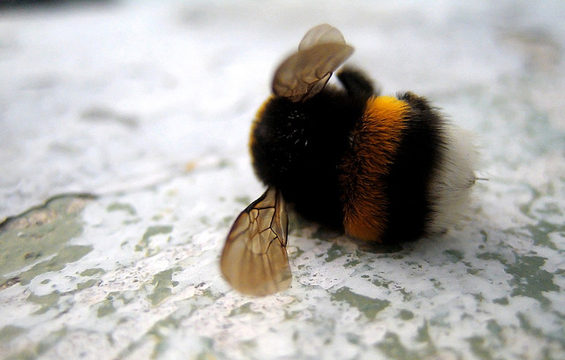
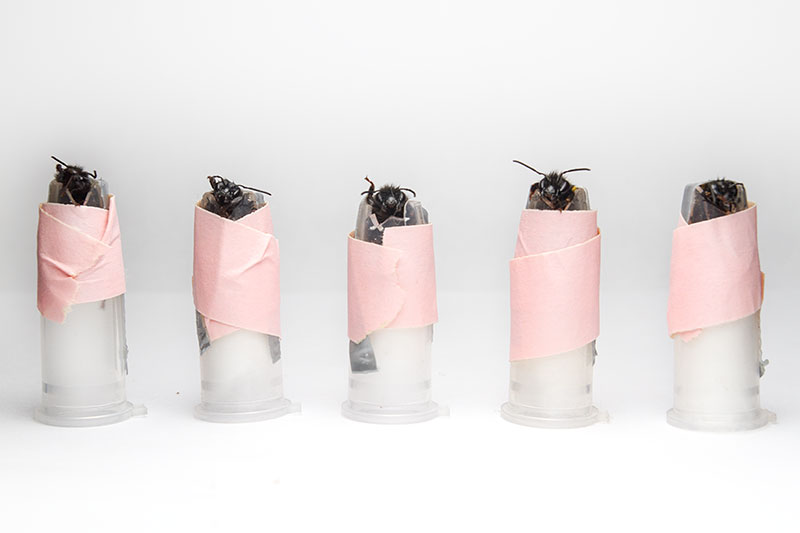
 Results from my newly published work,
  PhD: I’ve embarked on a 3.5 year research PhD investigating pathogen spillover from commercial bumblebees colonies to native bees. Based at the University of Leeds with Dr William Hughes, the work will be done in partnership with the bumblebee conservation trust.